45 understanding fat on nutrition labels
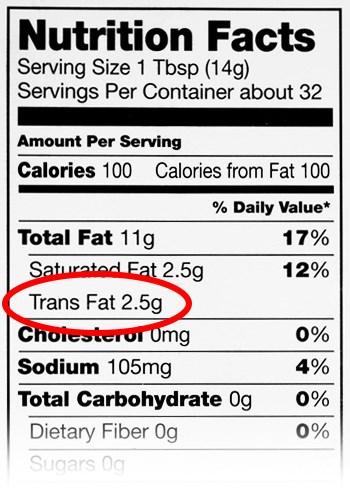
How to Understand and Use the Nutrition Facts Label | FDA Saturated fat, sodium, and added sugars are nutrients listed on the label that may be associated ... Understanding Food Nutrition Labels | American Heart Association Mar 06, 2017 · When the Nutrition Facts label says a food contains “0 g” of trans fat, but includes “partially hydrogenated oil” in the ingredient list, it means the food contains some trans fat, but less than 0.5 grams per serving. So, if you eat more than one serving, you could end up eating too much trans fat.
Nutrition facts tables - Canada.ca The information in a nutrition facts table is based on the serving size. Serving size can be found at the top of the nutrition facts table. You can use a nutrition facts table to compare the serving size to the amount of food you actually eat. For example, the serving size of bread in a nutrition facts table could be 1 slice.

Understanding fat on nutrition labels
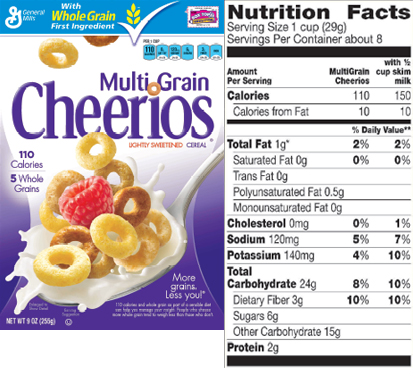
Understanding Food Nutrition Labels | Sanford Fit Nutritional Information When looking at fat, carbohydrates, sodium, added sugar, and vitamins, the percent Daily Value (%DV) is a good guide. The percent Daily Value (%DV) will show how much of a nutrient is in a serving of food and contributes to a total daily diet. A general guide: 5% DV or less of a nutrient per serving is considered low. Understanding food labels - Canada.ca About nutrients, fats, vitamins on nutrition facts table, on packaged foods. Nutrient content claims Meaning of fat-free, no added sugar, low sodium, other nutrient content claims. Fat Content on Food Labels - Reading Between the Lines When it comes to listing fat on food labels, manufacturers are required to only list total fat and saturated fat. Some also voluntarily list monounsaturated and polyunsaturated fat, but it's unlikely you'll see trans fat listed."
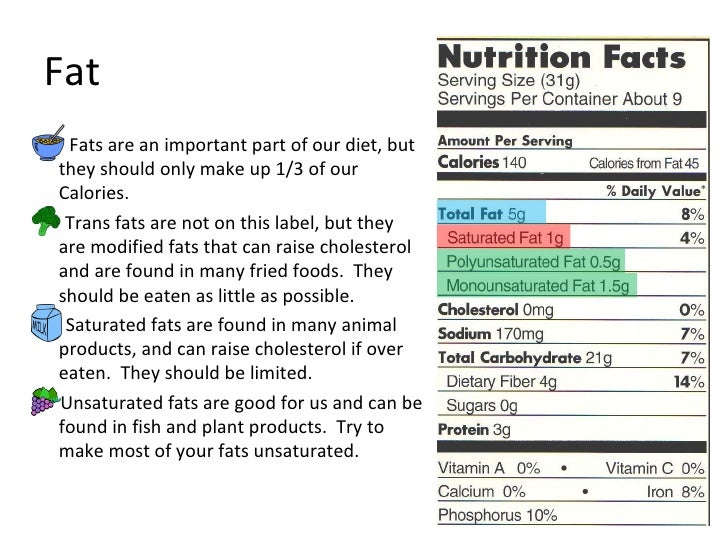
Understanding fat on nutrition labels. Understanding Nutrition Labels - Facty Health Know Your Fats Not all fats are the same. Unsaturated fat is essential for the normal functioning of the body, but saturated fats can negatively impact health and should be limited. A nutritional label lists saturated fat separately, so this is the value to pay attention to. You'll also see a line for cholesterol. Food Labels | CDC - Centers for Disease Control and Prevention If you eat the whole thing, you are eating 8 times the amount of calories, carbs, fat, etc., shown on the label. Total Carbohydrate shows you types of carbs in the food, including sugar and fiber. Choose foods with more fiber, vitamins, and minerals. Choose foods with lower calories, saturated fat, sodium, and added sugars. Avoid trans fat. Understanding Nutrition Labels: LabelCalc It's important to know that percent daily values are not required for all the mandatory nutrients on your nutrition facts label. Below is a list of nutrients that must be accompanied by a percent daily value on the current label: Saturated fat; Total fat; Cholesterol; Sodium; Total carbohydrate; Dietary fiber; Vitamin A; Vitamin C; Iron; Calcium Understanding Food Labels | The Nutrition Source | Harvard T ... All FOP labels in the U.S. are voluntary, which allows food manufacturers to highlight or hide the nutrition information they choose to help promote or preserve sales. If warning labels became mandatory, as public health advocates propose, the pressure on manufacturers would increase to change certain products to improve their nutritional quality.
Get Smart On Carbs | ADA - American Diabetes Association As you’ll see on the nutrition labels for the food you buy, the term “total carbohydrate” refers to all three of these types. The goal is to choose carbs that are nutrient-dense, which means they are rich in fiber, vitamins and minerals, and low in added sugars, sodium and unhealthy fats. Looking at labels - British Nutrition Foundation What are nutrition and health claims? Nutrition claims: these relate to what a product does or doesn’t contain, or contains in a higher or lower amount. For example: ‘Sugar free’ (must contain less than 0.5g sugars per 100g) ‘Low fat’ (must contain less than 3g fat per 100g) ‘High in fibre’ (must contain at least 6g fibre per 100g) Food Labels: Fat & Cholesterol | Home & Garden Information Center The Nutrition Facts label shows you how much fat is in a product, even if the fat is hidden as an ingredient. The serving size and the nutrients listed on this label are consistent, which makes it easy to compare similar products without any calculations. % Daily Values (% DVs) are listed in a column on the "Nutrition Facts" label. By looking at these percentages, you easily can determine whether a food contributes a lot or a little of a particular nutrient to your daily diet. Tips for understanding the Nutrition Facts Labels Currently, the Nutrition Facts lists Total Fat, Saturated Fat, Trans Fat, and Cholesterol. Eating too much of these can increase your risk of chronic diseases, such as heart disease, some cancers, and high blood pressure. While too much fat can have health consequences, we certainly need fats and cholesterol for our body to function properly, such as our hormones.
Understanding Nutritional Labels | Beaumont | Beaumont Health Here are the parts of most food labels: Calories (total calories and calories from fat) - This part of the label tells you how many calories each serving has and how many of those calories come from fat. Total Fat - Total fat is the number of fat grams per serving. There are different types of fat. Some are good for you and some aren't. 20 Tips for Understanding Nutrition Labels | Eat This Not That Macronutrients include fat, carbs (which also breaks down into fiber and sugar), and protein. If anything stands out to you—like the product having 17 grams of fat or 25 grams of sugar—use those numbers to help you skim the ingredient list. For example, a cereal that has 6 grams of fat in it is odd. Understanding Nutrition Fact Labels | Penn Highlands Healthcare Understanding Nutrition Fact Labels. One of the best ways to take greater control of your health is by better understanding what you eat and drink in a day. Fortunately, the Nutrition Fact labels on nearly everything we buy gives us this exact information. ... Too much saturated fat and sodium are associated with an increased risk for ... Understanding Ingredients on Food Labels | American Heart ... Mar 06, 2017 · Understanding Ingredients on Food Labels Food labels are an important source of information about calories and the nutritional value of the foods you eat, a crucial tool in building a heart-healthy diet.
HOW TO READ NUTRITION FACTS: food labels explained for fat loss - YouTube
Interpreting Total Fat and Types of Fat on Food Labels - Nina Cherie ... Interpreting Total Fat and Types of Fat on Food Labels. The Nutrition Facts label lays out the "total fat" in addition to the different types of fat contained in foods. Determining the type of fat can help you decide whether or not a food is rich in 'healthy' and/or 'unhealthy' fats. Trans fats and, in some cases saturated fats, are considered "unhealthy" or "bad" while monounsaturated and polyunsaturated (omega-3) fats are generally healthier alternatives or "good" fats.

32 What Is Total Fat In Nutrition Label - Label Design Ideas 2020
Understanding Food Nutrition Labels - American Heart Association When the Nutrition Facts label says a food contains "0 g" of trans fat, but includes "partially hydrogenated oil" in the ingredient list, it means the food contains some trans fat, but less than 0.5 grams per serving. So, if you eat more than one serving, you could end up eating too much trans fat.

Reading a Canadian Nutrition Label – Sprouting Health
Knowledge, Attitudes and Understanding of Low-fat Nutrition Labels ... Evaluating the Knowledge, Attitudes and Understanding of Low-fat Nutrition Labels/Claims among University Students. Abstract. Background: Studies have shown that Traffic Light (TL) nutrition labels can be effective in directing consumers towards healthier food choices. While the self-reported understanding of labels is relatively high (>50%), it is not reflective of its actual use.

Nutrition Label Highlighting Unhealthy Trans Fats Stock Photo (Edit Now) 162622850 - Shutterstock
Understanding the Nutrition Facts Label - Know Diabetes by Heart For individuals on an insulin to carb ratio—you can use the Nutrition Facts label to help you add up the total grams of carbohydrates you are eating, then divide by the ratio. For example, let's take this label once again. If you are eating 2/3 of a cup of this product, it would be 37 grams of carbs. Let's say you were also going to have ...
how to read a nutrition label
How to read food labels: MedlinePlus Medical Encyclopedia If a food has less than 0.5 grams of saturated fat in the serving size on the label, the food maker can say it contains no saturated fat. Remember this if you eat more than 1 serving. You should also pay attention to trans fats on any food label. These fats raise "bad" cholesterol and lower your "good" cholesterol.
Don't Fear The Fat! Add These Healthy Fats Back Into Your Diet | Allrecipes
Understanding and Using the Nutrition Facts Label Nutrition Facts . Calories . 230. Amount per serving Total Fat . Saturated Fat 1g . Trans . Fat 0g . Cholesterol . 0mg . Sodium Total Carbohydrate . 37g Dietary Fiber 4g Total Sugars 12g Includes ...

26 Nutrition Label Worksheet Answers - Labels 2021
Understanding Food Nutrition Labels | American Stroke Association When the Nutrition Facts label says a food contains "0 g" of trans fat, but includes "partially hydrogenated oil" in the ingredient list, it means the food contains some trans fat, but less than 0.5 grams per serving. So, if you eat more than one serving, you could end up eating too much trans fat.

All About Fats - Heart Fit For Life
Fat Content on Food Labels - Reading Between the Lines When it comes to listing fat on food labels, manufacturers are required to only list total fat and saturated fat. Some also voluntarily list monounsaturated and polyunsaturated fat, but it's unlikely you'll see trans fat listed."

Types of Milk Explained: Whole Milk, 2 Percent, Skim and More | Milk Life
Understanding food labels - Canada.ca About nutrients, fats, vitamins on nutrition facts table, on packaged foods. Nutrient content claims Meaning of fat-free, no added sugar, low sodium, other nutrient content claims.
Fats in the Diet - GI for Kids
Understanding Food Nutrition Labels | Sanford Fit Nutritional Information When looking at fat, carbohydrates, sodium, added sugar, and vitamins, the percent Daily Value (%DV) is a good guide. The percent Daily Value (%DV) will show how much of a nutrient is in a serving of food and contributes to a total daily diet. A general guide: 5% DV or less of a nutrient per serving is considered low.

How to Read a Label | Nutrition labels, Nutrition, Labels

Managing Caloric Intake With Food | Nutrition Facts : The Truth Facts About Food, Fruit, Vegetable
33 Nutrition Label On Cheerios - Labels Database 2020

Understanding Food Labels - Food Ingredient Facts regarding Understanding Food Labels22594 ...

Krames Online - Reading Food Labels

NCDA&CS - Kid's World - Understanding Food Labels

How to Read a Nutrition Facts Label - RunEatSnap
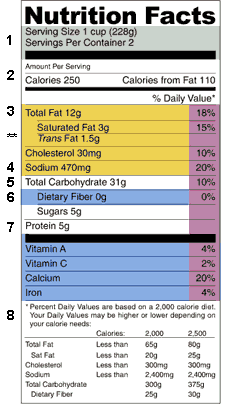
Food Labels — School of Medicine University of Louisville
Post a Comment for "45 understanding fat on nutrition labels"